Showing posts with label pagoda. Show all posts

Friday, 19 May 2017

[Buyeo] - Jeongnimsa Temple Site and Five-story Stone Pagoda

It took about 10 minutes bus ride from Gudeurae Dolssambab Restaurant (near Gudeurae Sculpture Park) to Jeongnimsa Temple Site.

The ending scene of "Moonlight Drawn by Clouds" was filming at this park...

When we joined the tour, this park not included in Buyeo City Tour. Maybe after this drama, they also put it as one of the must visit places in Buyeo during Autumn when they're blooming.

I'd love to visit this beautiful field full of pink cosmos flowers which the background might be Busosan Fortress and Baengmagang River.

 King Seong Statue at the centre of Buyeo City.

Jeongnimsa Temple Site is just behind Buyeo Middle school.

Ticket Office and Visitor Information.

Directory Map.

Exhibition gallery.

Five-story pagoda and Lecturer Hall at the background.

Bud-shaped Granite Basin with Lotus decoration inside it,
which seemed related to Buddhist temple.

     Lotus Pond near Pagoda. 

Lotus is the symbolic flower in Buyeo for its splendid yet simple and graceful. It is considered the ‘noble man’ among the flowers.

Jeongnimsa Five-story Stone Pagoda.

 
This five- story Pagoda in Jeongnimsa Temple Site to enshrined Buddha's Sarira
was built in the early 6th century when Baekje transferred its capital to Buyeo.
It's designated as National Treasures No. 9.

 I'm always amazed and failed to understand how
people in the past constructed pagoda in such perfect shape.

 
 How did they select the appropriate proportion of granite 
for every part of pagoda from base to top?

 Do you notice the rising curve of each corners?
I really wonder how they shape it so nicely.

The height of this pagoda is 8.33 m, so how did they carry and
stack those heavy granites the top? Did it take moths or years to build it?

 Really hat off for their skills to build this
grand and sophisticated stone pagoda!

 After General So Jeongbang from Tang who destroyed Baekje by allying with
Silla inscribed  a comment on first story body of pagoda saying 
“Monument for conquest of Baekje.”

 
Therefore, this pagoda was once known as 'Pyeongjetap.'
This implied the importance of its location for Baekje.
 (The inscribed words on the right vertical pillar, but not so obvious).

 Prayer hall, lecture hall and the monks’ dormitories that once stood on
this site were wooden buildings constructed on tiled platforms.

The guide explained to us about female and male roof. It's the first time I heard that roof also has gender. But that's all I understood as she conveyed it in Korean language.

So, I searched the internet and found this link. Apparently, in accordance with principles of Yin-Yang, Korean roof divided into 2 types: Male (Convex) and Female (Concave). Wow... pretty interesting!

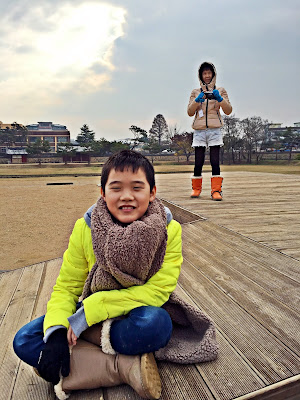
 My hubby and kids just resting at open stage.

 I'd to delete about hundred photos because my hubby and my daughter
busy with camera and HP snapping battles!

Jeongnimsa Seated-Buddha Statue
(Treasure No. 108), which enshrined in the
middle of the temple facing five-story pagoda.

This Buddha was made during Goryeo Dynasty. 
Only the pedestal and the body of Buddha remain because the
original sitting stone Buddha was seriously damaged and burned. 

The head and hat were restored at a later time. The pedestal has been preserved well and shows refined and balance craftsmanship. Therefore, although it is difficult to identify the details of Buddha statue, it's considered to have been made with care.

 Judging from narrow shoulder and the hands placed around the chest, 
this Buddha seems to be Vairocana.

The temple where this Buddha Statue was enshrined was built in mid sixth century.
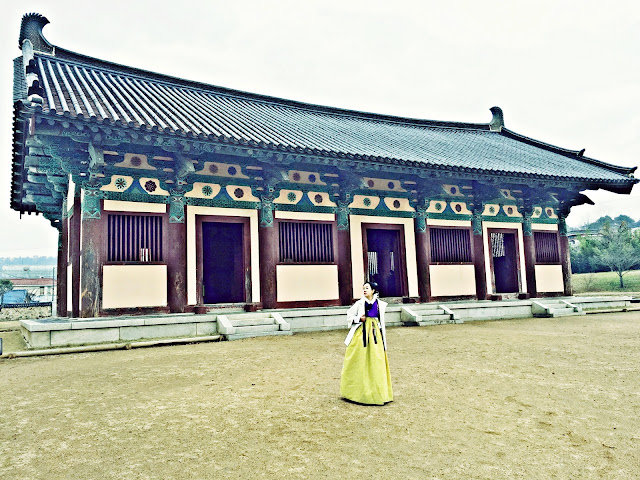
The name, 'Jeongnimsa' was given when it's reconstructed during the Goryeo Dynasty.

 This temple site was previously used as the lecture hall during Baekje period. 

This historical site in Buyeo is worth visiting to know more about historical materials during Baekje and Goryeo. No wonder there were so many locals and students were there during our visit.

 Add: 83, Jeongnim-ro, Buyeo. Korea
Website: www.buyeo.go.kr

Tuesday, 18 August 2015

[Kyoto] - Kiyomizudera Temple (音羽山清水寺)

Kiyomizudera Temple - a must visit UNESCO world heritage site in Kyoto | by Meheartseoul
Our brief 15 minutes visit to Kiyomizudera Temple...ㅠㅠ

 This photo was taken at squarish 9m x 9m Tamura Hall with beautiful
hip-and-gable roof (Irimoya-zukuri). Waiting to collect entrance tickets
before left our group and go down the hill to Okamoto Kimono Rental.


 Inner Map of Kiyomizudera Temple.

Finally reached Muromachi style Niomon (仁王門 =Deva Gate)
after mad rush uphill walk with this traditional Kimono. Phew~!


Two Diva Kings, one on either side standing inside the green latices, and  
a pair of  Komainu (狛犬 = Lion-dogs) stand guard to protect temple
and prevent evil spirit to enter the temple ground.


Kiyomizu temple was registered as UNESCO world heritage site in 1994.

The open-mouth Deva is commonly placed to the right, and the closed-mouth Deva to the left. Each is named after a particular cosmic sound. The open-mouth figure is called  Agyō (阿形), who is uttering the sound “ah,” meaning birth. His close-mouth partner is called Ungyō (吽形) who sounds “un” or “om,” meaning death. Both combined become sacred word “OM” (オン in Japanese / 唵 in Chinese / 옴 in Korean). 

In Korea normally you'll find Four Heavenly Kings guarding the Korean Buddhist Temples.

 
Spectacular view the city of Kyoto and Kyoto Tower in the distance.


Gable roof (Kiritsuma-zukuri) with six pillars Bell Pavilion (Shoro)
supported this 2 ton of giant bell.


From here, you can see busy Kiyomizu-michi street selling
souvenirs, local foods, Kimono, arts, handicrafts, ceramics, pottery,
confectionery, tea and so on.


Ups? What happen to the highest three-storey pagoda (三重塔 =Sanju-no-to) in Japan?!!


FYI, Kiyomizudera is currently under renovation until 2019.
You'll see grandeur Kiyomizu temple if you're coming for Olympic in 2020.

Nine of the buildings at Kiyomizudera are being renovated step by step.  Currently, the Okunoin Hall, which is well known for the temple's secondary balcony and the neighboring Amida Hall and Shaka Hall are being renovated. Furthermore, a few structures around the entrance, including the 3-storied pagoda, have been wrapped up for renovation. The construction has a certain but not overwhelming impact on a visit. Later in the decade, the Main hall will also undergo renovation which can be expected to have a bigger impact on a visit. (source)

    
Withered cheery blossom looking sadly at blanketed Pagoda...
 

Kaizando (Tamura-do Hall)  beside Pagoda.


  Zuigudo (随求堂) Hall worshiping mother of
Budda Daizuigu Bosatsu (大隨求菩薩).

 
 There is a completely dark hall inside Zuigudo Hall called "Tainai Meguri"
Entering this hall symbolizes you are inside Zuigu Bosatsu or mother's womb.
Feel your own light in the complete darkness!


   Lots of Ema hanging here because Zuigu Bosatsu has
power to fulfill  all kinds of wishes!^^


Simple unpainted Shaka-do Hall has nice detailed hipped roof
(Yosemune-zukuri).


Kiyomizudera Main Hall (Hondo).

The principal image of the Juichimen Senju Kannon Bosatsu  (a standing statue of Eleven-faced  Buddhist Goddess of Mercy) is enshrined in  inside Zushi (a miniature Buddhist shrine). It's  which is only displayed to public once every 33 years.

Hondo main hall is is designated as a national treasure, and it's the main attraction of the temple

Main hall Kiyomizu Stage sitting on the cliff of Otowa Mountain.

The most interesting part is they did not use a single nail to construct this platform stage. They meticulously chosen beech tree (櫸木) as it said that it can stand up to 800 years. It has been surviving earthquakes, rain, wind and withstand thousands of visitors per day. The next reconstruction of these 139 giant pillars in crisscross pattern only required in year 2430. Wow~! isn't it awesome?!!

In fact, Kiyomizu-dera Temple was selected as one of the finalists for the New Seven Wonders of the World in 2007.


Although the Secondary Hall (Okuno-in Temple) is under renovation,
but at least I can enjoy the nice view of cherry blossom.

A hidden Buddhist statue of Senju Kannon is the oldest three-faced,one thousand-armed Kannon Bosatsu, which still remains in Japan.

Koyasu Pagoda on the opposite mountain with greenery of spring!

Koyasu means “an easy childbirth,” visit this pagoda will automatically bring ease to any woman’s childbirth and have her baby safely. 

Unfortunately, we're not fated to go down to the Waterfall Pond.

Kiyomizu means pure water (清い水) in Japanese. Actually, most of the people visit the temple  to drink drink its sacred "Ougon-sui (golden water)" water from Otowa-no-taki  Waterfall,  and pray for Rokkonshoujyou (Purification of the six roots of perception).

The waterfall is divided into 3 streams. They have same purpose to bring you health, longevity, and wisdom. So, you can choose to drink from either one of the streams, and not all. Note that being greedy will only bring you misfortune!

 
Do you really need to jump to make wish come true?!

The expression "to jump off the stage at Kiyomizu" (清水の舞台から飛び降りる) is the Japanese equivalent of the English expression "to take the plunge". 

This refers to an Edo period tradition that held that, if one were to survive a 13m jump from  Kiyomizu stage, his wish would be granted, but now this practice is prohibited.


 Reminding myself to be grateful for everything that I have.
 I do believe in Karma, so let's just do more good deeds!

May all sentient beings be free from sufferings, and I also pray that passengers of  Sewol ferry could return safely.


These were last few photos we took before leaving the temple...

   
Or else, the coach will leave without us!


Our guide had warned us for not to be late, as we're heading to Osaka after this. He smiled and asked not to worry... he told us to gave the taxi driver the hotel address in Osaka (printed on our itinerary). The taxi fee is just around 20,000 Yen. He converted it to SGD and MYR for us. What? SGD 225! 

But, I don't mind staying here!

Then, he said very expensive, right?! Then, he taught us this free method to go to Osaka! You should cry as loud as possible. Most of Japanese people are kind and will try to help you. But, you shouldn't talk and say anything... you can make it more dramatic sitting on the floor and cry and using hand language. They might call the police to help you... then you might be sitting inside the police car, and safely arrive at the hotel without paying a single cent! Hahaha... love his crazy idea, but I think it'll only work if you're really a good actor or actress!

 
No worry... be happy!~^^


Address: 1 Kiyomizu, Higashiyama-ku, Kyoto-shi, Kyoto
Admission Fee: 200 Yen (Student) / 300 Yen (Adult)
Opening hours: 6:00 - 18:00
Directions:
* Bus No. 206 from Kyoto Station to Gojozaka (10 mins), and walk to the temple (10 mins ).
* Bus No. 207 from Shijo-Kawaramachi to Kiyomizu-michi bus stop (6 mins) and walk to the temple (10 mins ).


Not sure whether this is Chawan-zaka (Teapot street) that is also leading
to Kiyomizudeera Temple. This alley is less busier than Kiyomizu-michi.

Kiss Kiss Kyoto~! Love this rustic and ancient city so much!


Related Posts:


Korean Buddhist Temple | meheartseoul.blogspot.com