Visitors of ACM can discover the unique and rich art through folk performances. Some of these traditional dances were designated as Korea's important intangible cultural assets.
In general, there are two types of folk dance in Korea: 'Shamanic' and
'Court' dances. Shamanic folk dances that were created and performed in
the villages during festivals and religious holidays. Korean court
dances is called 'Jae' (정재) which mean to display talent including dance
and other performing arts. Jeongjae were used to perform for the royal
family, court officials, and foreign envoys or for festive occasions.

Korean Traditional Performances.
People rushed to the foyer once they heard the performance going to start soon. Although I rushed there, but people foyer were already crowded. Most of the people were standing because the seats were limited. The crowd was almost blocked the walking way to gallery.

A troupe of male performers (Namsadang) entering with traditional music instruments.
Namsadangnori (남사당놀이) usually is like a circus. It's usually included six distinct performance: Pungmulnori
(풍물놀이), Beona nori (버나놀이), salpan (살판), eoreum (어름), deotboegi (덧뵈기),
and deolmi (덜미) involving various activities such as music,
acrobatics, stunt, play, and dance.
Samul reflects the number of four (사물 = Samul) percussion instruments used for the performance. It said to be derived from four instruments in Korean Buddist Temple called 'Un-u-pung-roe (雲雨風雷)' which combining the sound between heaven and earth:
1. Barrel Drum (북 = Buk) resembling to blowing cloud.
2. Hourglass drum (장구 = Janggu) resonating the rain.
3. Large Gong (징 = Jing) echoing the wind.
4. Small Gong (꽹과리 = Ggwaenggwari) producing thundery sound.
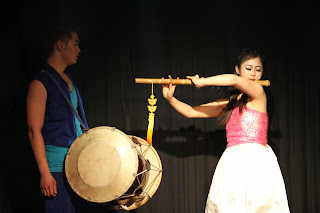
If you noticed in the video, a man wearing white hanbok standing at the right corner blowing something like small trumpet. It's called Taepyeongso / Hojeok (태평소 / 호적) which is occasionally used as additional instrument.
The moment strong traditional music mixturing these four instruments started to play,
I somehow feel like being teleported back to the old Joseon Dynasty...
I somehow feel like being teleported back to the old Joseon Dynasty...

Sajamu (사자무 ) Lion Dance
"Hey, is that lion?!" My daughter asked because it's our first time encountering Korean Lion dance. We watched so many time of Chinese Lion Dances, which is usually performed during Lunar New Year, but the lion appearance was cute and funny unlike those Chinese lions.


Liar Lion acted as camel and snake.
This masked lion was a humourous performance especially when the lion suddenly has 2 humps popped up and walked around. Arabic music was played to matched the performance. After that this liar lion turned to a long snake and started to slithering around and sticking out his red tounge and ended. The performance ended with the lion shaking hands with audiences with his 'snake' tongue ;P

Pungmulnori (풍물놀이) Spinning Hat Performance.
Pungmulnori was one of the oldest folk performance in Korea which originally played to wish for a
good harvest. Deeply rooted from farming
lifestyle and culture therefore it's known as farmer's music (nong'ak/농악).
It's a great source of entertainment for the farmers to enjoy farming, gathering and sharing the joy and grief together. Feel the farmers' spirit through the unique and creative art of drumming and dancing.
The terms samulnori and pungmul are often used interchangeably. Samulnori is sitting style (앉은반 = anjuban) and more emphasis on the music from four percussion while Pungmulnori is standing style (선반 = seonban) involving music, dance and acrobatics.
Donned in traditional clothing with cloth ribbons. The bright color of ribbons representing Sky (blue), Earth (red) and Human (yellow). Hats
are another component of the costumes: Sangmo is a black round hat, which was army helmet during Goguryeo dynasty. A flowery pointed white hat ggoggal (풍물 꼬깔) is the most common head-dress, originated from hats worn by Buddhist monks.
Some advanced
performers wear sangmo attached with long ribbon. The long riboon will flow in the air and draw patterns whenever the performers spinning and flipping their heads.

Bupochum (부포춤) Hat Performance.
There's another hat that looks like a flower called Bupochum. Kinda interesting and fun hat to wear because the white feathers will created different flower blooming illusions such as sunflower, lotus, daisy and so on when the performer move his head up, down, forward, backward or bending their knees. It's so amazing yo~!

Beonanori (버나놀이 ) Spinning Dish Dance.
Beona refers to a circular disc-shaped object made of leather. Beona is quite similar to spinning saucers or plates in Chinese circus.
As part of the performance, they teased each others and show off their skills. Started with the basic spinning with stick, then tossing and exchange the objects. Then they change the stick to fan, swords and 2 items together.
The performers also invited few audiences to spin the disc with the stick. Hahaha... oh well it's not easy as you think ;P

Salpan (살판) Acrobatics Performance.
The word Salpan comes from the phrase “If you do well, you will be alive (salpan), and if you don't, you will be dead" (jookeulpan).”
These salpan performance was ridicously incredible. I don't know how
they managed to play the instrument, spin and flip their head and doing 'B-Boy' acrobatics stunts like flipping and flying?! Jinjja Daebak!!!

Energetic and lively choreography with all the performers showing their skills
and the strong music beats creating the excitement vibes. Cool! 멋지다~!!!

Hope to watch Pungmulnori, the representative art performance of Korea
during opening ceremony for Pyeongchang Olympics 2018.

The original image of cute Soohorang credited to talented artist Magic Frog.

I don't know how to draw or paint, so these cartoonist Soohorang
performing Pungmulnori, Beonanori and Bupochum was by
painstakingly checking the videos to get the matching positions,
then merging, deleting the unused parts and editing them.

Geommu (검무) Sword Dance.
Geommu,
Korean Sword Dance is one of the important intangibles assets. It's
originated during the twelfth century the later portion of the Three
Kingdoms of Korea. Geommu was rearranged by the Royal Court and
recreated by the Gisaeng during Joseon Dynasty.

Gisaeng 'Hwang Jin-Yi' performing sword dance.
Geommu is performed with special costume, dance
motions, and music. The dance is known for its grace in performance.
Extra emphasis is placed on the movement of the costuming, notably the
sleeves, in harmony with the movements of the dancer.

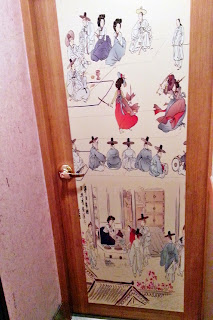
Watching
this live was like watching K-drama 'Painter of the Wind' when Yun Bok
and Danwon had to paint 'Fight' as the topic. He painted 'Dance with
two swords' (쌍검대무) and Kim Hong Do painted 'Ssireum' (씨름).
This 'fierce' dance was one of my favorite folk performances, therefore I purposely stayed in Jeonju Hanok Hotel which the hotel using some
of Yun Bok's famous paintings including 'Scenery on Dano day' (단오풍정). If you're curious about these two painters, please check my previous post to read more about paintings exhibiting at ACM and particularly standing portrait of Seo Jik-su painted by Yi Myeong-gi and Kim Hong do.

Jangguchum (장구춤) Hourglass Drum Dance.
Janggu Dance is combining beating hourglass drum which stripped between dancers' shoulder and waist with rhythmic and graceful dance.

Janggu class with KTO VIP Tour members at Jeongdong Theater
before watching traditional musical performance 'Miso.'
It's interesting and fun experience to learn how to beat janggu and holding 2 sticks (Gungchae and Yeolchae) properly. At the end of the class, we managed to play three sets of basic rhythms (장단 = Jangdan). Please check my pervious post if you're interested to know more about janggu.

Buchaechum (부채춤) Fan Dance.
Fans were
widely used in dances and rituals as they're belived to bring prosperity
and expel evil apart from their useful and decorative functions. This fan dance is said to be one of the most beautiful and appealing folk dances of Korea.
The dancers wearing bright hanbok gracefully manipulate their fans while syncronicing their dance movements according to the music. Billowy hanbok flowing when the dancers turning was extremely charming.

Seungmu (승무) Buddhist Dance
This dance based on ritual (Bubgo) dances of Buddhist monks was once banned by the Joseon Court. Then it was transformed into a folk dance and developed mostly by gisaengs. Now it's preserved as one of the Cultural Properties of Korea.
The dancer wears a robe (jangsam) with long sleeve called gasa and white hood called gokkal. The drum (bubgo) is the most important part of Seungmu.
The seungmu integrates the eight rhythmic cycles mixture of flowing movements and stillness. Every now and then, when one rhythm shifts to another, the dancer changes the mood by changing the steps.
It's a serene and soul-stiring dance contributed by flowing super long white sleeves, dignified movements and slow traditional rhythmic drum beats.

My most favorite dance still remain the cool and stricking Ogomu
(five drum dance) after watching 'Gu Family Book' and 'Miso'

Hope that Pyeongchang Olympics will be presenting the beauty of
Korean culture and arts through these impressive folk dances.
Related Posts: