Showing posts with label UNESCO World Heritage. Show all posts

Friday, 30 December 2016

[Buyeo] - Busosanseong Fortress (부소산성) Tour

[Korea] - [Buyeo] - Busosanseong Fortress (부소산성) Tour | by Meheartseoul
There were few people sitting at A Twosome Place cafe also waiting for Buyeo City Tour. When the bus arrived in front of Gongju station, the waitress told the group. I quickly went out asked the driver whether we can join the tour as we didn't have the ticket yet. I asked him how much we need to pay , but he just asked us to board the bus. Really thankful because the driver didn't abandon us there although we didn't register.

Arrived in Buyeo, the ancient capital of Baekje Kingdom.


At  Buyeo Tourist Information Centre, they asked why we didn't register, I explained and showed them email that I asked assistance for booking, including email directly to Buyeo office but failed. Actually, I was prepared if they reject us we'll just hire a taxi to bring us to the attraction places as shown on the itinerary. Luckily, we just need to pay the tour fees and after received our lanyard we quickly boarded the bus...

The only foreigners joining this City Tour...

We're ready to explore the city of UNESCO World Heritage with 234 ruins and relics hidden in every corner in this city where Baekje culture and spirit alive!

Itinerary for Buyeo City Tour for Saturday Course: Gongju Station (9:30) -> Busosanseong Fortress parking lot (10:00) -> Busosanseong Fortress tour and traditional ferry (10:00-12:00) -> Lunch (12:00-13:00) -> Jeongnimsa  Temple Site (13:00-13:40) -> Saturday Traditional  Music performance (14:00-  15:30) -> Neungsan-ri Ancient Tombs (15:50-16:50) -> Busosanseong Fortress  parking lot (17:00) -> Gongju Station (17:30).

 = Busosanseong Fortress (부소산성) UNESCO World Heritage =

 Tourist map of key attractions in Buyeo.

Buso Mountain Fortress Gate.

Listening to tour guide explanation...

Busosanseong was called Sabi Fortress or Sabiseong or Soburiseong Fortress. It consists of the inner fortress divided by roads centered on the royal palace, a defensive fortress called "Buso Mountain Fortress", and outer walls surrounding the palace.

 then moving up...

Buyeo National Cultural Property Center.

previously function as Buyeo National Museum.


Map of Busosanseong Fortress Trail.

The tour guide introducing this map... but I only understand few percent as she delivered it in Korean language. We joined in last minute and I think 99% joining this tour were Koreans.

  Anyway, in that era commoners walked from one point to another point. 

So, their breakfast, lunch and dinner at the different locations. Only King or higher rank people riding horses... But now we're taking cars to go around... 

Maybe the fortress was stretched all the way to city area too 
because our guide pointed to Buyeo town.

 Interpreted those that I understood to these "question marks" faces.

 Though it's winter, but the trees still pretty with autumn foliage.

Started our fortress walking tour from here.

 We're going to Baekhwajeong Pavilion, 
Nakhwaam Rock and Goransa Temple.

Felt like I was traveling back to Buyeo era, and having some leisure walk (산책 = sanchaek) through this fortress.

A pleasant stroll shaded by colorful leaves and sometimes the snow falling from the trees.


Appreciate that it's brick road, so it must be much easier to walk and 
it's not slippery, especially it's a bit drizzling.

 
 and didn't want to stain my pretty hanbok.

Our guide noticed my Hanbok, and commented that it's very nice and I wore it even I'm a foreigner. They didn't even wear it. Well, if I know we need to cut through the woodland we'll wear something more appropriate and comfortable, but too bad we only found it out then.


 Seoboksa Temple is the site of a royal prayer temple during Baekje period.

Excavated relics included clay Buddha statue, roof-end tiles
with lotus design and mural painting.

It's a refreshing experience for us to stroll through 
the forest fortress along the calm river.

Didn't expect that it's on foot, and I even though donned myself in Hanbok. Well, there's no big deal although we'd to walk up and down through this hilly path with some steps for close to 2 hours. In fact, it's kinda therapeutic and powerful healing for busy hectic life.


Related Posts:


Wednesday, 22 July 2015

[Kyoto] - Nijō Castle (二条城)

Nijō Castle - A must visit heritage site in Kyoto | by Meheartseoul
Kyoto is a charming city with multihued local customs and rich in traditions. Flourished as the capital of Japan for as long as 1000 years after 794.  Kyoto nestled 13 temples, 3 shrines and the Nijo Castle.

Excited to see the itinerary as we'll visiting World Heritage sites in Kyoto: Nijō Castle (二条城), Rokuon-ji / Temple of the Golden Pavilion (鹿苑寺/金閣寺), Kiyomizu-dera (清水寺).

www.meheartseoul.blogspot.sg | Nijō Castle (二条城)
 Nijo Castle was our first stop, as it's near to Hotel Granvia Kyoto. 
About 15 minutes coach ride from Kyoto Station.

www.meheartseoul.blogspot.com | Nijō Castle (二条城) 
Are you sure this photo was taken around 9:00 am? 

www.meheartseoul.blogspot.sg | Nijō Castle (二条城)
 Ninomaru Higashi-otemon (higashi = east and mon = gate) 
has sturdy and strong gate to defend against enemy attack! 

 www.meheartseoul.blogspot.com | Nijō Castle (二条城)
 Let's learn more about Japanese culture and 
history of epic Shoguns and Samurais...

www.meheartseoul.blogspot.sg | Nijō Castle (二条城) 
 Introduction of Nijo Castle - UNESCO World Heritage Site since 1994
in Japanese, English, Chinese and Korean languages.
  
www.meheartseoul.blogspot.com | Nijō Castle (二条城)
 No worry... just listen to our experience tour guide.
Do you think he look like Japanese more than Taiwanese?
Especially when he speaks Japanese... wow!!!

www.meheartseoul.blogspot.sg | Nijō Castle (二条城)
 The castle was originally built in 1603 as the official residence
of Tokugawa Ieyasu, the first Shogun of Edo Period.

Tokugawa used Edo as the capital city, but Kyoto continued to be the home of the Imperial Court. Kyoto Imperial Palace is located north-east of Nijo Castle.

www.meheartseoul.blogspot.sg | Nijō Castle (二条城)
  Beautiful Ninomaru-goten Karamon has decorative Chinese-style roof ceiling.


www.meheartseoul.blogspot.com | Nijō Castle (二条城)


Showtime of Shogun and Samurais begin from this Karamon gate!

www.meheartseoul.blogspot.sg | Nijō Castle (二条城)
I heard footsteps on the rooftop! Flying Ninja?! OMG~!

www.meheartseoul.blogspot.com | Nijō Castle (二条城)
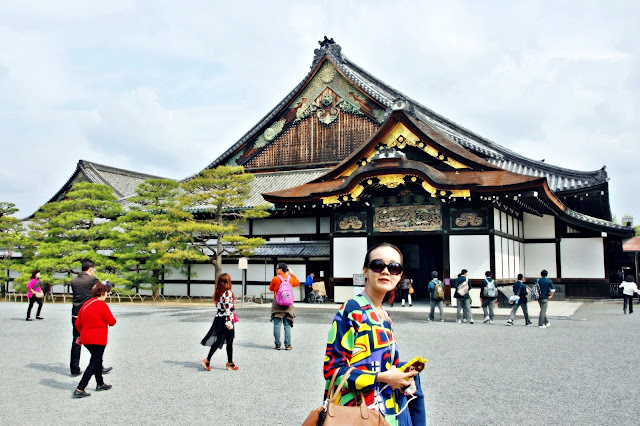
Kurumayose entrance way decorated with ranma-chokoku (a carved transom and 
a decorative frieze consisting of carved panels fixed above the head of a door).

On the front is depicted are five luan (a mythical Chinese bird), pine trees, peonies and at the top clouds, and at the bottom you can see grass. On the roof is cypress bark and the base is made of squared masonry. 

http://micro.rohm.com/en/rohm-saijiki/nijoujou/seasonview_nijoujou.html
Inner Map of Nijo Castle.

Nijo Castle is one of the epitome of early Edo period and Momoyama culture in Japan with splendid building designs, lavish paintings and carvings that generously commissioned.

First of all, you need to take off your shoes before entering 3300 square meter Ninomaru Palace. It consists of 5 connected separate buildings with made of Hinoki cypress wooden floor. The palace rooms are tatami mat covered

www.meheartseoul.blogspot.com | Nijō Castle (二条城)


Do note that no photography is allowed inside too. It's to protect the original colors of replica paintings on wall paintings.


www.meheartseoul.blogspot.sg | Nijō Castle (二条城)

Nightingale floors (Uguisubari) welcoming us with the squeaking sound like birds chirping when we stepped on it. The squeaking sound is not produced by the floorboard, but by the offset metal hinges triggered when it's under pressure.

Too many people inside, so no matter how soft I walked or slided, the floor bed still squeaked~~~! I need to learn from Ninja how to traverse a nightingale floor without making sound.

According to my guide Ninjas aware of this deadly alarm, because once it squeaked, the occupants will send Samurais out. Therefore, as what we normally watch in movie scenes... they have to 'fly' on the roof to avoid this nightingale board. This is the only way to attack occupants without knowing their presence.

www.meheartseoul.blogspot.com | Nijō Castle (二条城)

Entering the building, you can see few chambers, offices and the living quarters of the shoguns. Some of the rooms have mannequins of Shogun and and his subordinates, officers and attendants.

Our tour guide explained to us, but somehow my Chinese language skill only for basic conversation. It's kinda hard for me to understand. Scratched my head with all these new and unfamiliar words!

To make it worse, there's a tour guide using loudspeaker to explained in strange and unfamiliar foreign language. What?!! Ok... Alright, you won! I'd to off my ears and on my eyes to admire those impressive classical wall and screen paintings.

www.meheartseoul.blogspot.sg | Nijō Castle (二条城)
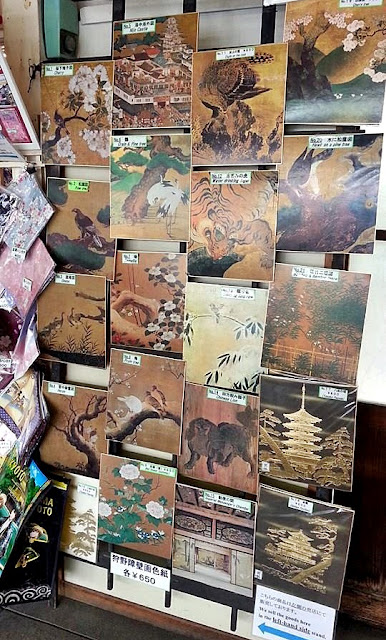
 These are some of the paintings found inside
the castle, and you can buy for souvenirs.

www.meheartseoul.blogspot.com | Nijō Castle (二条城)
Icecream from teahouse / souvenir shop to cold my head
before proceeding to next destination... Golden Pavilion.

www.meheartseoul.blogspot.sg | Nijō Castle (二条城)
 Bansho (Guard House) at the back,
previously 50 Samurais were stationed there at a time.
   
www.meheartseoul.blogspot.com | Nijō Castle (二条城)
The entire castle grounds and the Honmaru are surrounded by 
huge stone walls and deep moats. 

 Nijo Castle truly demonstrates the power that the Shoguns wielded over the emperors in Japan throughout Edo period.

www.meheartseoul.blogspot.sg | Nijō Castle (二条城)
Add: 541 Nijojo-cho, Nijo-dori, Horikawa Nishi iru, Nakagyo-ku
 Hours and Fees Hours 8:45 to 17:00 (admission until 16:00) 
Entry to Ninomaru from 9:00 to 16:00 
English audio guides are available for 500 yen.

Related Posts: 

http://meheartseoul.blogspot.com/2015/07/kyotokinkakujigoldenpavilion.html

http://meheartseoul.blogspot.com/2015/08/kyotoheianshrine.html